About

FOUNDER & SCIENTIFIC LEAD

David Cheishvili, PhD is the founder and scientific lead of Biotech Insight Solutions, a specialized consulting practice serving molecular diagnostic laboratories, biotechnology companies, and research organizations.
He brings more than 25 years of experience in molecular biology, epigenetics, cancer biomarkers, clinical NGS, bioinformatics, assay development, and translational diagnostics.
David works directly with clients to translate research-stage assays into validated, documented, and operational testing workflows, from laboratory development and LDT validation to quality systems, bioinformatics assessment, and inspection-readiness planning.

BRIDGING RESEARCH AND CLINICAL IMPLEMENTATION

Biotech Insight Solutions was created to address a recurring challenge: promising molecular assays often require substantial validation, documentation, workflow development, and technical review before they can be implemented in a laboratory.
David Cheishvili, PhD brings experience across academic research, wet-lab biology, bioinformatics, biomarker development, translational biotechnology, and molecular diagnostics. This multidisciplinary background allows the firm to evaluate both the underlying science and the practical requirements of laboratory implementation.
The focus is turning complex molecular discoveries into
clear, documented, and sustainable testing workflows
that laboratory teams can validate, operate, and maintain.

HOW WE WORK

Biotech Insight Solutions works directly with laboratory and biotechnology teams to define the problem, review the available science and documentation, and establish a practical implementation plan.
Each engagement begins with a focused assessment of the assay, workflow, validation status, quality processes, or technical documentation requiring support.
Depending on the project, clients may receive a written gap assessment, prioritized action plan, validation strategy, SOP or documentation package, workflow review, or technical recommendations for laboratory implementation.
The objective is to provide
clear, usable deliverables that laboratory teams can implement and maintain.
Scientific & Technical Expertise
David Cheishvili, PhD brings more than 25 years of experience across molecular biology, epigenetics, cancer biomarkers, clinical NGS, bioinformatics, assay development, and translational diagnostics.
This multidisciplinary background enables Biotech Insight Solutions to assess both the scientific basis of an assay and the practical requirements for validation, documentation, data analysis, and laboratory implementation.
Education & Research Training
  • Postdoctoral Research in Epigenetics and Cancer Biology
McGill University
Postdoctoral research focused on DNA methylation, cancer biomarkers, transcriptional regulation, and epigenetic mechanisms in disease, providing a scientific foundation for biomarker development and molecular assay translation.
  • PhD in Biochemistry and Molecular Biology
    Hebrew University of Jerusalem, Faculty of Medicine
    Research focused on inherited genetic disease, gene regulation, and epigenetic biology.
  • MSc in Biochemistry and Molecular Biology
    Hebrew University of Jerusalem, Faculty of Medicine
    Training in molecular biology, biochemistry, gene expression, and experimental disease biology.
  • BSc/MSc in Biomedical Ecology
    Kutaisi State University, Georgia
Selected Consulting Experience
David Cheishvili, PhD has supported molecular diagnostic and epigenetic testing programs involving clinical NGS, DNA methylation assays, genetic risk assessment, assay validation, quality systems, bioinformatics, and laboratory implementation.
Selected experience includes scientific and technical support for programs associated with HKG epiTherapeutics and EpiMedTech Global, including:
  • CAP- and CLIA-related documentation, SOP organization, quality-system preparation, and inspection-readiness support
  • Validation planning and documentation for molecular diagnostics, clinical NGS, DNA methylation assays, and biomarker-based workflows
  • Bioinformatics and result-level assessment for targeted sequencing, methylation-based assays, and genetic risk assessment workflows
  • Technical support for programs moving from research development toward clinical and commercial implementation
Programs supported were associated with publicly announced organizational milestones, including CAP laboratory accreditation, CLIA registration, and FDA registration activities for genetic and epigenetic tests.
Selected public announcements:
FDA registration is not equivalent to FDA clearance, approval, or authorization of a diagnostic test.

NEED CLINICAL LAB CONSULTING SUPPORT?


Biotech Insight Solutions supports molecular diagnostic laboratories and biotechnology teams with assay implementation, LDT validation, quality systems, NGS workflows, bioinformatics assessment, scientific documentation, and inspection-readiness planning.

Discuss your laboratory, assay, or documentation needs and the practical deliverables required to move the project forward.

DISCUSS YOUR PROJECT

Latest Insights

Clinical Laboratory Consulting
3 min read
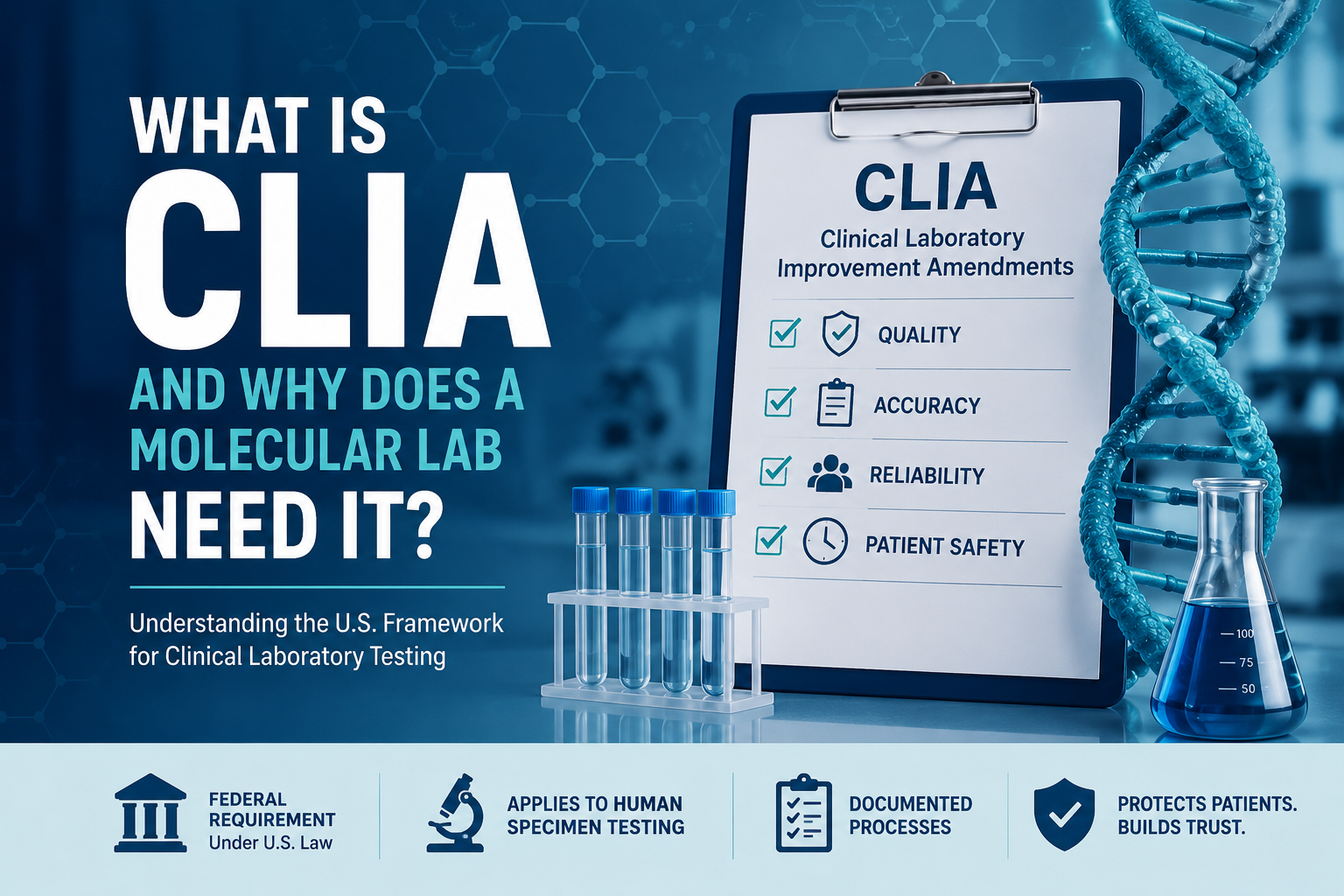
What Is CLIA and Why Does a Molecular Lab Need It?
CLIA stands for Clinical Laboratory Improvement Amendments. In simple terms, CLIA is the U.S. framework for clinical laboratory testing on human specimens. If a laboratory tests human samples and reports health-related results, CLIA may apply. This can include testing used for diagnosis, treatment, prevention, or general health assessment. In practice, a research assay is not automatically a clinical laboratory test. Once results are used for patients or clients, the lab needs a controlled and documented testing process.

Why molecular labs should care

Molecular testing is rarely one step. A result may depend on sample handling, DNA or RNA extraction, PCR, qPCR, sequencing, bisulfite conversion, bioinformatics, QC review, and final reporting. If any part of that workflow is unclear, undocumented, or poorly validated, the final result becomes harder to defend.

What changes when testing becomes clinical?

In research, methods can evolve. Samples can be excluded. Analysis can be repeated. The goal is usually discovery. Clinical testing is different. The laboratory must show how each result was generated, reviewed, reported, stored, and corrected if something went wrong. For a molecular lab, this usually means clear documentation for:
  • sample receipt and acceptance criteria;
  • test method and workflow;
  • assay validation or verification;
  • quality control rules;
  • bioinformatics analysis and review;
  • result reporting;
  • record retention;
  • corrective actions.

The common mistake

Many teams think about CLIA too late. They first focus on the biomarker, publication, sequencing data, or commercial opportunity. Those are important, but they are not enough for clinical testing. Before offering a molecular test, the lab should be able to answer practical questions:
  • What is the intended use of the test?
  • What specimen types are accepted?
  • What are the QC pass/fail rules?
  • What happens when a sample fails?
  • Who reviews and approves the result?
  • Is the bioinformatics pipeline documented?
  • Are SOPs and validation records inspection-ready?

Where consulting helps

A consultant does not issue a CLIA certificate and does not replace CMS, CAP, the laboratory director, legal counsel, or an accrediting organization. The practical value is gap identification. For example: incomplete SOPs, unclear validation plans, weak QC logic, missing bioinformatics documentation, or reporting workflows that do not match the assay. Fixing these issues early is much easier than trying to repair them during inspection, after launch, or after clients are already waiting for results.

Bottom line

CLIA is not just paperwork. It is part of the system that separates research testing from clinical laboratory testing. For molecular diagnostics, the assay, SOPs, validation, QC, bioinformatics, reporting, and documentation must work together. Biotech Insight Solutions helps clinical laboratories, biotech companies, and research groups identify these gaps and build practical molecular diagnostic workflows that are documented, validated, and ready for clinical laboratory use. Disclaimer: This article is for general educational purposes only. It is not legal, regulatory, accreditation, or medical advice. Laboratories should consult CMS, CAP, qualified regulatory professionals, legal counsel, and applicable accrediting organizations for decisions about CLIA certification and clinical laboratory operations.
autor
by Biotech Insight Solutions
Clinical Laboratory Consulting
6 min read
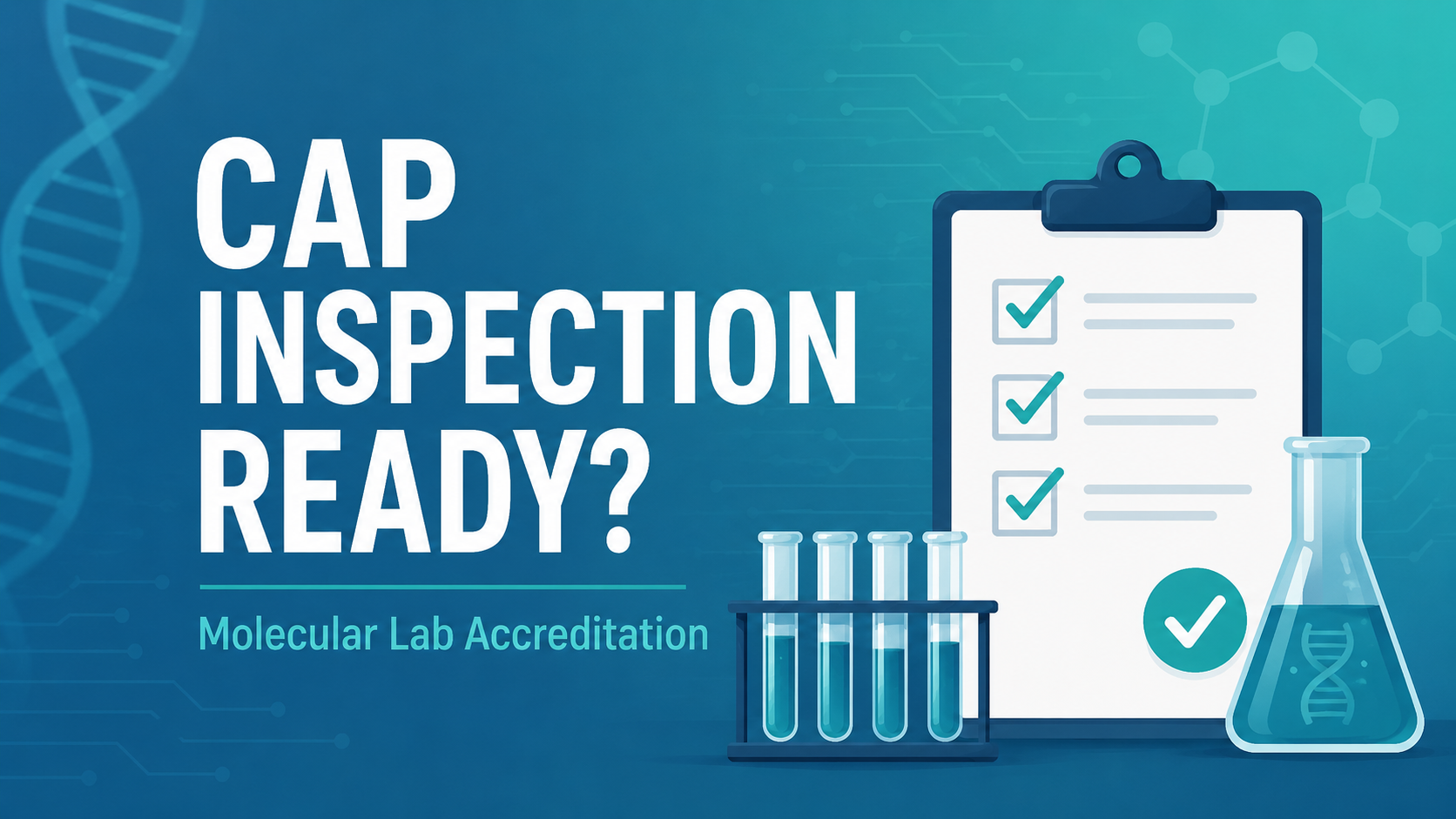
CAP Accreditation Is Not Just Paperwork: What Molecular Labs Should Prepare Before Inspection

For many molecular laboratories, CAP accreditation can look like a documentation exercise: policies, SOPs, checklists, signatures, training records, QC logs, and validation files. But in practice, CAP inspection readiness is not just about having documents. It is about whether the laboratory can show that its testing process is controlled, traceable, scientifically justified, and consistently followed.

This matters especially in molecular diagnostics, where testing workflows often include many connected steps: sample handling, nucleic acid extraction, PCR or targeted NGS, library preparation, sequencing, bioinformatics analysis, result interpretation, report generation, and quality review.

If one part of that chain is poorly documented, the whole workflow becomes vulnerable during inspection.

CAP Looks at the Laboratory as a System

A molecular test is not just an assay. It is a system.

That system includes the people performing the work, the instruments, the reagents, the SOPs, the validation evidence, the QC rules, the proficiency testing plan, the bioinformatics pipeline, the reporting process, and the laboratory director’s oversight.

This is why inspection readiness should not be treated as a last-minute activity before an inspection. A laboratory should be able to show that quality practices are embedded into routine work.

Common Weak Points in Molecular Laboratories

In my experience, molecular labs often have strong scientific teams, but the documentation does not always reflect the quality of the science. The work may be technically sound, but the evidence is scattered across spreadsheets, sequencing reports, email threads, instrument exports, validation drafts, and informal notes.

That becomes a problem when an inspector asks a basic question:

Can you show how this test was validated, how performance is monitored, and how you know the result is reliable?

Common gaps include:

  • validation summaries that do not clearly define intended use;
  • SOPs that do not match current laboratory practice;
  • QC acceptance criteria that are not clearly justified;
  • unclear documentation of failed runs, repeats, or troubleshooting;
  • bioinformatics pipelines that are used clinically but not adequately version-controlled;
  • insufficient linkage between wet-lab QC and final result interpretation;
  • proficiency testing or alternative assessment records that are incomplete;
  • unclear responsibility for final review and sign-out.

Validation Should Tell a Clear Story

For laboratory-developed tests and modified molecular assays, validation is not simply a folder of data. A good validation package should tell a coherent story:

  • what the test is intended to detect;
  • what specimen type is used;
  • what the reportable range or reportable result categories are;
  • how analytical sensitivity and specificity were evaluated;
  • how reproducibility and precision were assessed;
  • how interfering factors or limitations were considered;
  • how controls and QC metrics were selected;
  • how result interpretation is performed;
  • what limitations must be communicated in the report.

For clinical NGS and methylation-based assays, this becomes even more important. The laboratory must be able to connect the wet-lab process to the computational analysis and the final result. The bioinformatics pipeline is not separate from the assay. It is part of the assay.

Bioinformatics Is Part of Inspection Readiness

Clinical molecular laboratories increasingly depend on software, scripts, pipelines, reference files, genome builds, annotation databases, and versioned analysis workflows. These elements need documentation and control.

For targeted NGS, bisulfite sequencing, DNA methylation assays, or biomarker-based tests, a laboratory should be able to answer practical questions:

  • Which pipeline version was used?
  • Which reference files or marker definitions were used?
  • How are failed samples identified?
  • How are borderline or low-quality results handled?
  • Who reviews the sequencing QC?
  • Who reviews the final molecular interpretation?
  • How are pipeline changes validated before clinical use?

These questions are not only technical. They are quality-system questions.

Inspection Readiness Is Built Before the Inspection

A laboratory that waits until inspection notice to organize its quality system is already behind. The better approach is to build inspection readiness into routine operations.

That means:

  • keeping SOPs aligned with actual practice;
  • reviewing validation files before they are needed;
  • maintaining clear QC and troubleshooting records;
  • documenting assay changes and pipeline updates;
  • ensuring personnel training records are complete;
  • reviewing proficiency testing and alternative assessment documentation;
  • periodically checking whether reports, worksheets, and data review steps match the approved workflow.

The goal is not to create paperwork for its own sake. The goal is to make the laboratory’s testing process understandable, auditable, and defensible.

Final Thought

CAP accreditation is not just a certificate on the wall. For a molecular diagnostics laboratory, it is a test of whether the science, documentation, quality system, and clinical workflow are aligned.

A strong molecular lab does not only generate good data. It can explain how the data were generated, how quality was assessed, how results were interpreted, and how the process is controlled over time.

At Biotech Insight Solutions, I support clinical laboratories and biotech teams with molecular diagnostics, LDT validation, CAP/CLIA documentation, clinical NGS, bioinformatics review, SOPs, quality systems, and inspection readiness.

If your laboratory or biotech team needs support preparing molecular diagnostic workflows for clinical use or inspection readiness, request a consultation here.

Sources

autor
by Biotech Insight Solutions
Biotech Investment
4 min read
How to Evaluate Biotech Startups Before Investing
Investing in Biotech Startups can be one of the most rewarding—and riskiest—decisions you make. Breakthrough therapies and innovative diagnostics can deliver strong returns, but the industry is complex and technical. Unlike other industries, Biotech Startups often require deep scientific understanding to evaluate properly. Complex lab data, preclinical studies, and regulatory hurdles make it difficult to know whether the underlying science is sound. This guide will help you evaluate Biotech Startups before investing, so you can make informed, confident decisions.

1. Understand the Science in Biotech Startups

Look for clarity in how the startup explains its science. Can they describe it in understandable terms? Are their results published, peer-reviewed, or at least presented in detail? Is their approach truly novel or just an incremental improvement? Be cautious of companies that rely on jargon without explaining their work clearly.

2. Assess the Biotech Startup Team’s Expertise

A strong idea needs the right team to execute. Review the team’s scientific credentials and industry experience. Have they successfully developed products before? Is there expertise in regulatory approval and commercialization? The right team is essential for turning promising science into viable products.

3. Evaluate Technical Feasibility of Biotech Startups

Not all ideas can be scaled or manufactured cost-effectively. Assess whether the company’s approach is technically feasible at scale. Consider stability, delivery mechanisms, and whether their development timeline is realistic. Feasibility is often overlooked but can make or break a project.

4. Review the Regulatory Strategy for Biotech Startups

Biotech is heavily regulated. Understand the company’s plan for meeting regulatory requirements. Do they know which agencies they'll work with? Are they aware of the necessary clinical phases? Do they have a realistic budget and timeline for approval? A vague or unrealistic regulatory plan is a common red flag.

5. Analyze the Market Potential for Biotech Startups

Even if the science works, will there be demand? Evaluate the target patient population, unmet needs, existing competitors, and payer coverage. Strong Biotech Startups will have solid answers to these questions, supported by data.

6. Conduct Rigorous Scientific Due Diligence on Biotech Startups

This is critical. Review the underlying data carefully. Verify claims with independent experts if needed. Assess the risk of failure at each development stage. If you don’t have the in-house expertise, consider working with specialized firms that conduct scientific due diligence for Biotech Startups.

7. Examine Financial Planning for Biotech Startups

Biotech development is capital intensive. Check whether the company’s financial projections are realistic. How much funding will they need to reach key milestones? Is there a clear plan for using investor funds? Understand the risk of dilution in future funding rounds.

Final Thoughts on Investing in Biotech Startups

Investing in Biotech Startups requires balancing innovation potential with careful risk management. Don’t be swayed by marketing hype. Take a structured approach:
  • Evaluate the science critically
  • Assess the team’s expertise
  • Check technical feasibility
  • Understand the regulatory plan
  • Analyze market demand
  • Conduct thorough scientific due diligence
  • Review the financial plan carefully
At Biotech Insight Solutions, I provide scientific and technical review for biotech companies, investors, and laboratories working with molecular diagnostics, biomarkers, clinical NGS, and translational assays. My current consulting focus includes molecular diagnostics, LDT validation, CAP/CLIA documentation, clinical NGS, bioinformatics review, and scientific due diligence when needed. If you need support reviewing a biotech technology, diagnostic assay, biomarker program, or molecular testing workflow, request a consultation here.
autor
by Biotech Insight Solutions
Technology
4 min read
Why Going Digital Matters: My Thoughts and Advice
This blog is my personal opinion only. I’m not promoting any platforms or products — just sharing my ideas and observations.Today, the world is changing rapidly, and traditional methods of working with information are being replaced by digital technologies such as artificial intelligence (AI) and cloud storage. However, despite the availability of these tools, many people still use outdated methods, such as storing receipts in paper form or on physical media. My main message: digitalization is not only a trend, but also a necessity. It is convenient, reliable and saves time. Below, I will share my thoughts on why and how to make the transition to a digital format most effective.

Why You Should Move Away from Physical Media

Traditional methods of storing information — whether paper documents or files on a hard drive — have their limitations:
  • Vulnerability of physical media: Hard drives and flash drives can fail, get lost or simply become obsolete. Recovering data from such media often costs a lot of money, and no one guarantees success.
  • Inconvenient access: If you store documents on a physical medium, you can only access them from a specific device. This limits your mobility and creates difficulties when you need quick access.
  • The problem of systematization: Many people do not pay attention to organizing their files. The result is chaos, when business documents are mixed with personal ones, and the names of folders or files mean nothing after a year.

The Benefits of Cloud Storage

For myself, I chose to store all the necessary information in the cloud. Why does this solution seem optimal to me?
  • Access from anywhere in the world: You can open the file you need from your phone, computer or tablet, wherever you are.
  • Reliability: Cloud platforms provide data backup. Even if one server fails, your files will be available on other servers.
  • Saves space and time: You no longer need to buy additional devices for storing data, figure out how to connect them or worry about their safety.
Of course, I don’t store data that requires maximum confidentiality in the cloud, such as passport scans. But for copies of receipts, contracts, certificates and other documents, cloud storage is ideal.

How Artificial Intelligence Can Help You Stay Organized

Artificial intelligence has also become an important part of how I work with digital data. It has become something like a personal assistant for me, which helps:
  • Organize files: Sometimes the name of a folder seems clear at the time of creation, but after a year you can forget what it means. AI helps give folders clear and logical names that are easy to interpret even after a while.
  • Organize documents: Artificial intelligence helps automatically sort files into categories, whether they are family documents, business records or just personal notes.
I like to think of AI as a secretary who is available 24/7. Yes, you have to pay for such tools (usually about $30–40 per month), but they are worth the money. They save not only time, but also nerves.

Tips for Organizing Your Digital Files Effectively

  • Create folders with understandable names. For example, instead of “Documents”, it is better to write “Rent_2025” or “Business_contracts”.
  • Separate personal and work files. Do not store family photos together with reports.
  • Review your folder structure regularly — some things may become outdated, others may need updating.
  • Use artificial intelligence or automated sorting tools to minimize the human factor.

Conclusion: Start Your Digital Transformation Today

We live in the era of digital transformation. Cloud technologies and artificial intelligence are not just buzzwords, but real tools that make our lives easier. They do not replace us, but they become excellent assistants. The main thing is to learn how to use them correctly. The transition to a digital format and proper data organization takes time and effort, but this is an investment that will pay off a hundredfold. And if you have not started yet, now is the time.
autor
by Biotech Insight Solutions
arrow-to