
Insights
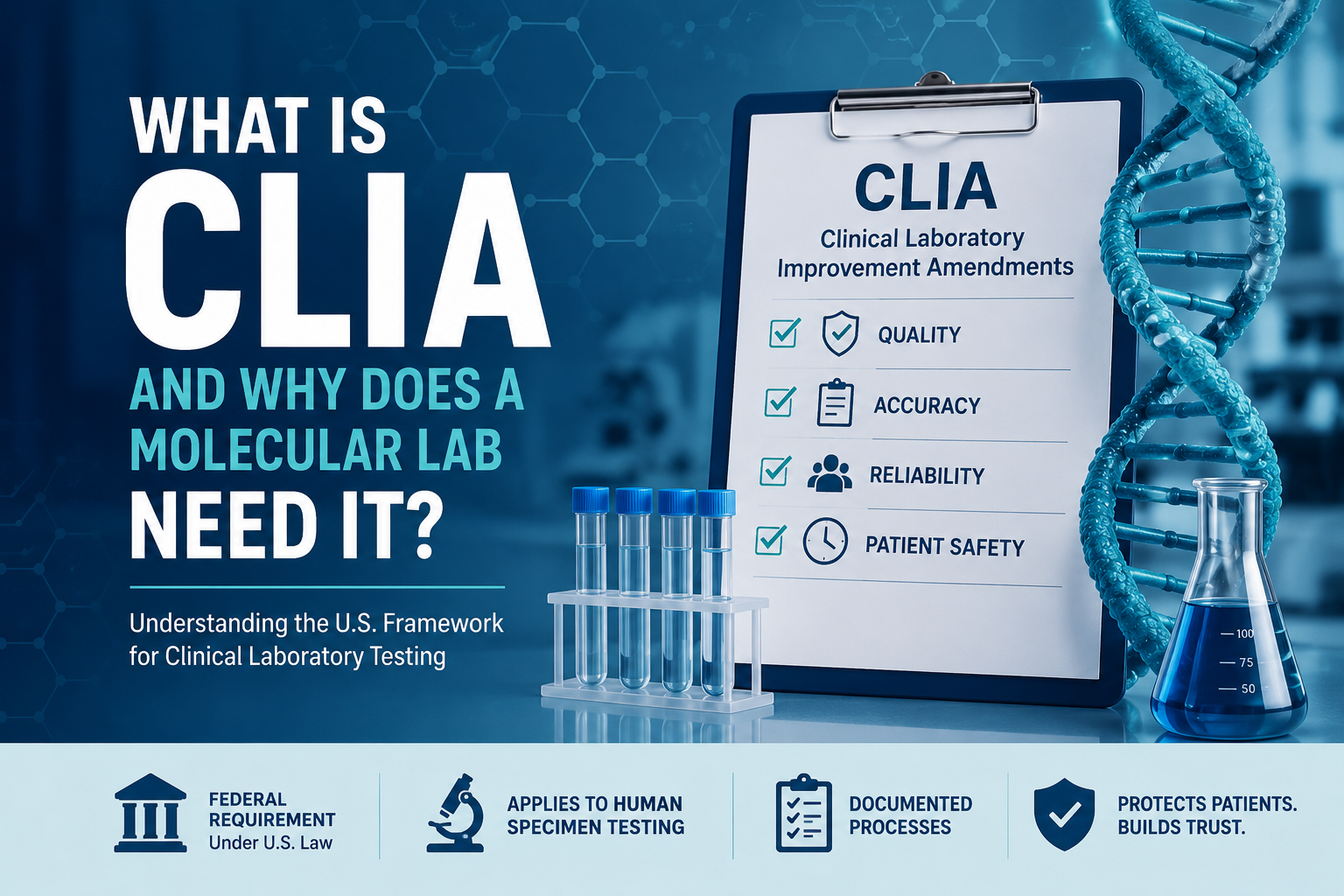

CLIA stands for Clinical Laboratory Improvement Amendments. In simple terms, CLIA is the U.S. framework for clinical laboratory testing on human specimens.
If a laboratory tests human samples and reports health-related results, CLIA may apply. This can include testing used for diagnosis, treatment, prevention, or general health assessment.
In practice, a research assay is not automatically a clinical laboratory test. Once results are used for patients or clients, the lab needs a controlled and documented testing process.
Why molecular labs should care
Molecular testing is rarely one step. A result may depend on sample handling, DNA or RNA extraction, PCR, qPCR, sequencing, bisulfite conversion, bioinformatics, QC review, and final reporting.
If any part of that workflow is unclear, undocumented, or poorly validated, the final result becomes harder to defend.
What changes when testing becomes clinical?
In research, methods can evolve. Samples can be excluded. Analysis can be repeated. The goal is usually discovery.
Clinical testing is different. The laboratory must show how each result was generated, reviewed, reported, stored, and corrected if something went wrong.
For a molecular lab, this usually means clear documentation for:
- sample receipt and acceptance criteria;
- test method and workflow;
- assay validation or verification;
- quality control rules;
- bioinformatics analysis and review;
- result reporting;
- record retention;
- corrective actions.
The common mistake
Many teams think about CLIA too late.
They first focus on the biomarker, publication, sequencing data, or commercial opportunity. Those are important, but they are not enough for clinical testing.
Before offering a molecular test, the lab should be able to answer practical questions:
- What is the intended use of the test?
- What specimen types are accepted?
- What are the QC pass/fail rules?
- What happens when a sample fails?
- Who reviews and approves the result?
- Is the bioinformatics pipeline documented?
- Are SOPs and validation records inspection-ready?
Where consulting helps
A consultant does not issue a CLIA certificate and does not replace CMS, CAP, the laboratory director, legal counsel, or an accrediting organization.
The practical value is gap identification. For example: incomplete SOPs, unclear validation plans, weak QC logic, missing bioinformatics documentation, or reporting workflows that do not match the assay.
Fixing these issues early is much easier than trying to repair them during inspection, after launch, or after clients are already waiting for results.
Bottom line
CLIA is not just paperwork. It is part of the system that separates research testing from clinical laboratory testing.
For molecular diagnostics, the assay, SOPs, validation, QC, bioinformatics, reporting, and documentation must work together.
Biotech Insight Solutions helps clinical laboratories, biotech companies, and research groups identify these gaps and build practical molecular diagnostic workflows that are documented, validated, and ready for clinical laboratory use.
Disclaimer: This article is for general educational purposes only. It is not legal, regulatory, accreditation, or medical advice. Laboratories should consult CMS, CAP, qualified regulatory professionals, legal counsel, and applicable accrediting organizations for decisions about CLIA certification and clinical laboratory operations.

CAP Accreditation Is Not Just Paperwork: What Molecular Labs Should Prepare Before Inspection
For many molecular laboratories, CAP accreditation can look like a documentation exercise: policies, SOPs, checklists, signatures, training records, QC logs, and validation files. But in practice, CAP inspection readiness is not just about having documents. It is about whether the laboratory can show that its testing process is controlled, traceable, scientifically justified, and consistently followed.
This matters especially in molecular diagnostics, where testing workflows often include many connected steps: sample handling, nucleic acid extraction, PCR or targeted NGS, library preparation, sequencing, bioinformatics analysis, result interpretation, report generation, and quality review.
If one part of that chain is poorly documented, the whole workflow becomes vulnerable during inspection.
CAP Looks at the Laboratory as a System
A molecular test is not just an assay. It is a system.
That system includes the people performing the work, the instruments, the reagents, the SOPs, the validation evidence, the QC rules, the proficiency testing plan, the bioinformatics pipeline, the reporting process, and the laboratory director’s oversight.
This is why inspection readiness should not be treated as a last-minute activity before an inspection. A laboratory should be able to show that quality practices are embedded into routine work.
Common Weak Points in Molecular Laboratories
In my experience, molecular labs often have strong scientific teams, but the documentation does not always reflect the quality of the science. The work may be technically sound, but the evidence is scattered across spreadsheets, sequencing reports, email threads, instrument exports, validation drafts, and informal notes.
That becomes a problem when an inspector asks a basic question:
Can you show how this test was validated, how performance is monitored, and how you know the result is reliable?
Common gaps include:
- validation summaries that do not clearly define intended use;
- SOPs that do not match current laboratory practice;
- QC acceptance criteria that are not clearly justified;
- unclear documentation of failed runs, repeats, or troubleshooting;
- bioinformatics pipelines that are used clinically but not adequately version-controlled;
- insufficient linkage between wet-lab QC and final result interpretation;
- proficiency testing or alternative assessment records that are incomplete;
- unclear responsibility for final review and sign-out.
Validation Should Tell a Clear Story
For laboratory-developed tests and modified molecular assays, validation is not simply a folder of data. A good validation package should tell a coherent story:
- what the test is intended to detect;
- what specimen type is used;
- what the reportable range or reportable result categories are;
- how analytical sensitivity and specificity were evaluated;
- how reproducibility and precision were assessed;
- how interfering factors or limitations were considered;
- how controls and QC metrics were selected;
- how result interpretation is performed;
- what limitations must be communicated in the report.
For clinical NGS and methylation-based assays, this becomes even more important. The laboratory must be able to connect the wet-lab process to the computational analysis and the final result. The bioinformatics pipeline is not separate from the assay. It is part of the assay.
Bioinformatics Is Part of Inspection Readiness
Clinical molecular laboratories increasingly depend on software, scripts, pipelines, reference files, genome builds, annotation databases, and versioned analysis workflows. These elements need documentation and control.
For targeted NGS, bisulfite sequencing, DNA methylation assays, or biomarker-based tests, a laboratory should be able to answer practical questions:
- Which pipeline version was used?
- Which reference files or marker definitions were used?
- How are failed samples identified?
- How are borderline or low-quality results handled?
- Who reviews the sequencing QC?
- Who reviews the final molecular interpretation?
- How are pipeline changes validated before clinical use?
These questions are not only technical. They are quality-system questions.
Inspection Readiness Is Built Before the Inspection
A laboratory that waits until inspection notice to organize its quality system is already behind. The better approach is to build inspection readiness into routine operations.
That means:
- keeping SOPs aligned with actual practice;
- reviewing validation files before they are needed;
- maintaining clear QC and troubleshooting records;
- documenting assay changes and pipeline updates;
- ensuring personnel training records are complete;
- reviewing proficiency testing and alternative assessment documentation;
- periodically checking whether reports, worksheets, and data review steps match the approved workflow.
The goal is not to create paperwork for its own sake. The goal is to make the laboratory’s testing process understandable, auditable, and defensible.
Final Thought
CAP accreditation is not just a certificate on the wall. For a molecular diagnostics laboratory, it is a test of whether the science, documentation, quality system, and clinical workflow are aligned.
A strong molecular lab does not only generate good data. It can explain how the data were generated, how quality was assessed, how results were interpreted, and how the process is controlled over time.
At Biotech Insight Solutions, I support clinical laboratories and biotech teams with molecular diagnostics, LDT validation, CAP/CLIA documentation, clinical NGS, bioinformatics review, SOPs, quality systems, and inspection readiness.
If your laboratory or biotech team needs support preparing molecular diagnostic workflows for clinical use or inspection readiness, request a consultation here.
Sources
