
Insights
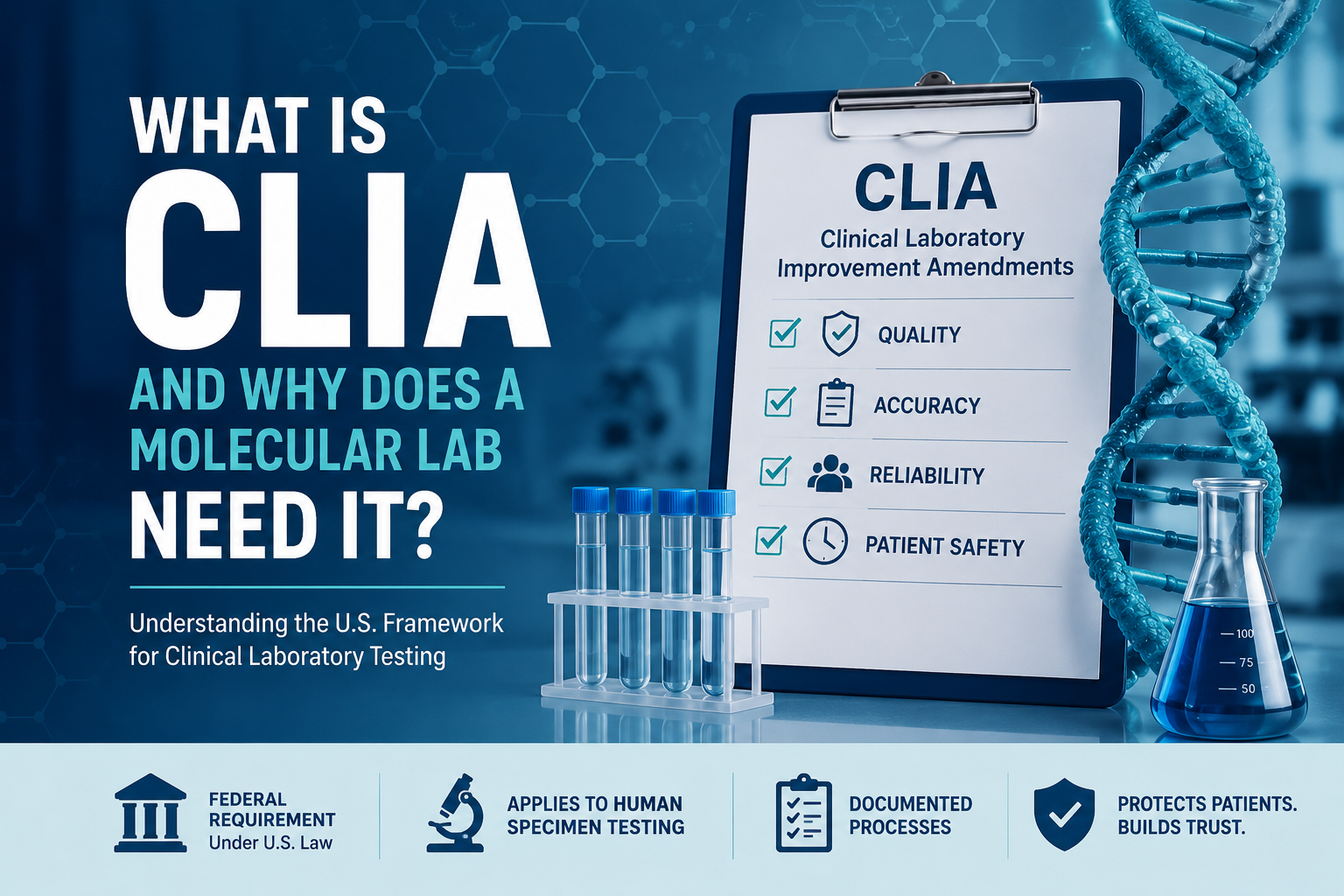

CLIA stands for Clinical Laboratory Improvement Amendments. In simple terms, CLIA is the U.S. framework for clinical laboratory testing on human specimens.
If a laboratory tests human samples and reports health-related results, CLIA may apply. This can include testing used for diagnosis, treatment, prevention, or general health assessment.
In practice, a research assay is not automatically a clinical laboratory test. Once results are used for patients or clients, the lab needs a controlled and documented testing process.
Why molecular labs should care
Molecular testing is rarely one step. A result may depend on sample handling, DNA or RNA extraction, PCR, qPCR, sequencing, bisulfite conversion, bioinformatics, QC review, and final reporting.
If any part of that workflow is unclear, undocumented, or poorly validated, the final result becomes harder to defend.
What changes when testing becomes clinical?
In research, methods can evolve. Samples can be excluded. Analysis can be repeated. The goal is usually discovery.
Clinical testing is different. The laboratory must show how each result was generated, reviewed, reported, stored, and corrected if something went wrong.
For a molecular lab, this usually means clear documentation for:
- sample receipt and acceptance criteria;
- test method and workflow;
- assay validation or verification;
- quality control rules;
- bioinformatics analysis and review;
- result reporting;
- record retention;
- corrective actions.
The common mistake
Many teams think about CLIA too late.
They first focus on the biomarker, publication, sequencing data, or commercial opportunity. Those are important, but they are not enough for clinical testing.
Before offering a molecular test, the lab should be able to answer practical questions:
- What is the intended use of the test?
- What specimen types are accepted?
- What are the QC pass/fail rules?
- What happens when a sample fails?
- Who reviews and approves the result?
- Is the bioinformatics pipeline documented?
- Are SOPs and validation records inspection-ready?
Where consulting helps
A consultant does not issue a CLIA certificate and does not replace CMS, CAP, the laboratory director, legal counsel, or an accrediting organization.
The practical value is gap identification. For example: incomplete SOPs, unclear validation plans, weak QC logic, missing bioinformatics documentation, or reporting workflows that do not match the assay.
Fixing these issues early is much easier than trying to repair them during inspection, after launch, or after clients are already waiting for results.
Bottom line
CLIA is not just paperwork. It is part of the system that separates research testing from clinical laboratory testing.
For molecular diagnostics, the assay, SOPs, validation, QC, bioinformatics, reporting, and documentation must work together.
Biotech Insight Solutions helps clinical laboratories, biotech companies, and research groups identify these gaps and build practical molecular diagnostic workflows that are documented, validated, and ready for clinical laboratory use.
Disclaimer: This article is for general educational purposes only. It is not legal, regulatory, accreditation, or medical advice. Laboratories should consult CMS, CAP, qualified regulatory professionals, legal counsel, and applicable accrediting organizations for decisions about CLIA certification and clinical laboratory operations.

